Ovron Motor
Choosing a Geared Electric Motor in 2026 requires more than comparing price, speed, and catalogue ratings. The right unit must match the machine’s real workload, not an ideal laboratory cycle. A conveyor moving boxed goods may need steady torque, while a packaging axis may demand frequent starts, stops, and reversals. Small errors matter. One overlooked load spike can overheat the motor or shorten gearbox life.
A reliable selection process begins with measurable details: required output speed, continuous and peak torque, duty cycle, supply voltage, starting conditions, and available installation space. Environmental factors also deserve close attention. Dust, washdown water, heat, vibration, and outdoor exposure can change the enclosure and sealing requirements. In practical engineering reviews, checking the motor, gearbox, brake, and controller as one system often reveals problems that separate product comparisons miss. Real conditions decide.
Efficiency remains important in 2026, but it should not replace mechanical judgment. A highly efficient motor can still perform poorly if its reduction ratio is wrong or its service factor is too low. Noise, backlash, maintenance access, and replacement availability may seem secondary during purchasing. They are not. A cheaper motor may create higher downtime costs later. That conclusion is easy to state, but actual decisions are rarely so clean. Budgets, delivery schedules, and imperfect specifications often compete with technical ideals. Careful documentation, manufacturer data, and consultation with qualified engineers help reduce that uncertainty. The best choice is usually the one that delivers dependable motion, safe operation, and practical long-term value.
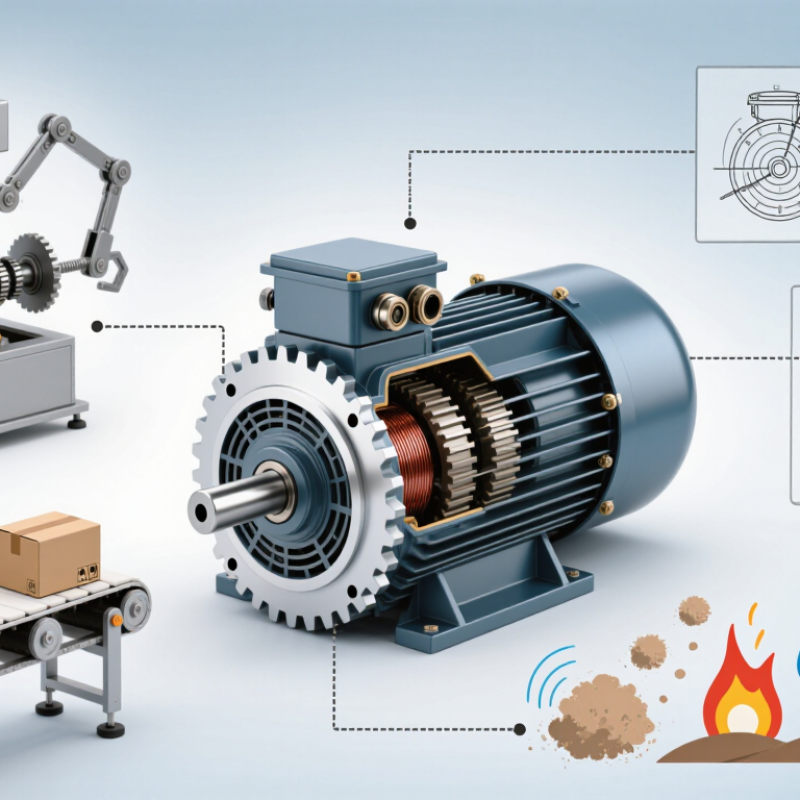
Choosing a geared electric motor in 2026 starts with the application, not the catalog. Define the load first. Record required output torque, speed, acceleration, operating hours, and reversals. Measure the load. A conveyor moving 600 kilograms at 0.3 meters per second needs different gearing than a mixer with intermittent shocks. Calculate shaft torque using T = 9550P/n for metric units, then check starting and peak torque. Do not size from rated motor power alone. The IEA’s Energy Efficiency 2024 analysis indicates electric motor systems consume roughly half of global electricity, making efficient matching important.
Duty cycle changes the answer. Specify continuous, intermittent, or frequent start-stop service, plus daily running hours. A 10-second start every minute can heat the gearbox differently from steady operation. Check ambient temperature, dust, moisture, washdown exposure, altitude, mounting position, and available voltage. Then define the output shaft, brake, backlash, permissible radial load, and noise limit. For safety-critical lifting, include holding requirements and an independent risk assessment. The U.S. Department of Energy reports that motor-driven equipment can account for about 70% of industrial electricity use. Efficiency is not a decoration.
It affects operating cost. Still, the perfect calculation is uncommon. Real loads surge. Conveyor friction changes with temperature, alignment, and product buildup. Use measured current, torque data, or a short trial when estimates conflict. A service factor may cover uncertainty, but it should not hide poor assumptions or oversizing. Document every requirement before comparing gearbox ratios, motor efficiency, thermal class, enclosure rating, and maintenance access. That record makes later troubleshooting far less subjective.
How to Choose a Geared Electric Motor in 2026?
Match motor power, torque, speed, and gear ratio before comparing prices. The International Energy Agency reports that motor-driven systems use about 53% of global electricity. Small sizing errors can therefore increase energy waste. Start with the load torque, output speed, duty cycle, and starting conditions. Use this practical formula: power in kilowatts equals torque in newton-metres multiplied by speed, divided by 9,550. A conveyor requiring 180 Nm at 60 rpm needs about 1.13 kW before losses.
Choose the gear ratio by dividing motor speed by required output speed. A 1,800 rpm motor needs roughly a 30:1 ratio for 60 rpm output. However, gearbox efficiency reduces available torque. Output torque equals motor torque multiplied by ratio and efficiency. Include acceleration, shock loads, braking, and continuous operation. The U.S. Department of Energy’s Motor Systems guidance emphasizes that correctly sized motors and efficient transmission systems reduce industrial energy losses. Oversizing feels safe, but it may lower efficiency and increase purchase costs.
Check the thermal rating, service factor, mounting position, and allowable radial load. The International Energy Agency’s Energy Efficiency 2023 analysis also highlights efficiency improvements as a major industrial energy opportunity. A spreadsheet can still lie. Real machines vibrate, start unevenly, and face dirt. I would recheck the calculated torque against measured current and one full operating cycle. The first estimate is rarely perfect.
| Application Load | Motor Power (kW) |
Typical Motor Speed (rpm) |
Motor Torque (N·m) |
Gear Ratio (:1) |
Estimated Output Speed (rpm) |
Estimated Continuous Output Torque (N·m) |
Recommended Duty or Equipment | Key Selection Check |
|---|---|---|---|---|---|---|---|---|
| Light intermittent load | 0.12 | 1,500 | 0.76 | 5 | 300 | 3.44 | Small conveyors, light feeders, positioning mechanisms | Confirm starting torque and short-term overload capacity |
| Light continuous load | 0.25 | 1,500 | 1.59 | 10 | 150 | 14.32 | Small rollers, inspection conveyors, compact mixers | Allow a service factor for frequent starts or variable loads |
| Moderate continuous load | 0.55 | 1,500 | 3.50 | 20 | 75 | 63.03 | Packaging conveyors, screw feeders, rotary tables | Check gearbox thermal capacity at the required output speed |
| Heavy continuous load | 1.10 | 1,500 | 7.00 | 20 | 75 | 126.05 | Material handling, loaded belt conveyors, agitators | Verify shaft, key, coupling, and radial-load limits |
| High-torque, low-speed load | 2.20 | 1,500 | 14.01 | 30 | 50 | 378.19 | Heavy conveyors, hoist drives with suitable braking, mixers | Check peak torque, braking requirements, and shock loading |
| Very high-torque industrial load | 4.00 | 1,500 | 25.47 | 30 | 50 | 688.36 | Bulk material handling, large mixers, process machinery | Confirm gearbox rating, thermal performance, and foundation stiffness |
Choosing a geared electric motor in 2026 starts with the gearbox, not the motor nameplate. The reduction mechanism determines speed, torque, heat, noise, and service life. Define the required output speed, continuous torque, starting torque, and duty cycle. Then calculate the ratio by dividing motor speed by load speed. Do not choose a ratio from speed alone.
Helical gearboxes suit continuous conveyors, mixers, and pumps requiring good efficiency and moderate noise. Planetary gearboxes provide high torque density and strong load sharing in compact equipment. Worm gearboxes offer large reductions in limited space, but they usually lose more energy as heat. Their self-locking behavior can also change with load, lubrication, and wear. Be careful. It is not guaranteed.
Check the output torque using motor torque, reduction ratio, and gearbox efficiency. Add a service factor for shock loads, frequent starts, or long operating hours. For example, a dusty conveyor may need better sealing and a higher thermal margin than laboratory equipment. Inspect the mounting position, shaft direction, backlash, and brake requirements before ordering. A small backlash error can affect indexing accuracy. A larger gearbox may run cooler, yet it can create alignment problems and unnecessary weight. I have found that real machines often challenge the original calculation. Recheck the design under actual temperature, load variation, and maintenance conditions.
Select the suitable gearbox type and reduction mechanism by comparing representative transmission efficiency and typical reduction capabilities.
Helical, bevel-helical, and planetary gearboxes generally provide high efficiency for continuous-duty applications. Worm gearboxes can achieve high reduction ratios in a compact package, but their sliding contact typically results in lower efficiency and greater heat generation. Actual performance depends on load, speed, lubrication, ratio, duty cycle, and operating temperature.
How to Choose a Geared Electric Motor in 2026?
Evaluate efficiency before comparing purchase prices. A motor that runs eight hours daily can make small efficiency differences financially significant. Check rated output, gearbox efficiency, and power-factor data under the actual load. Do not rely only on peak efficiency. It may occur far above your normal operating point. Measure twice.
Duty cycle matters just as much. Identify running time, starts per hour, reversing frequency, and peak torque. A conveyor moving heavy boxes needs different thermal capacity than a gate operating twice daily. Select a motor with suitable service factor, but avoid excessive oversizing. It can increase cost, starting current, and mechanical stress. I once treated intermittent operation as continuous duty, and the enclosure became warmer than expected.
Mounting must match the machine frame and shaft arrangement. Confirm flange dimensions, shaft diameter, keyway details, and allowable radial loads. Check whether the motor can be installed horizontally, vertically, or in both positions. Misalignment can create vibration even when the motor specifications appear correct. Leave practical space for inspection and replacement.
Operating conditions often decide reliability. Record ambient temperature, dust, moisture, washdown exposure, altitude, and available voltage. A sealed enclosure may protect against dust, but it can also retain heat. In cold environments, lubricant viscosity deserves attention. For variable-speed control, verify cooling performance at low speed and confirm the controller suits the motor. Keep written measurements, because memory is not a specification.
Choosing a geared electric motor in 2026 requires more than matching speed and torque. Controls affect daily performance. Confirm compatibility with variable-speed drives, soft starters, sensors, and braking systems. A basic controller may reduce purchase cost, but it can limit diagnostics later. Check overload protection, thermal monitoring, emergency stopping, grounding, and enclosure ratings. Moisture, dust, and washdown conditions need suitable protection.
Safety details matter during installation and servicing. Guards should cover moving parts, while accessible disconnects support safer isolation. Maintenance teams should inspect gear noise, shaft vibration, oil leakage, and housing temperature. Follow the manufacturer’s service intervals, but treat them as starting points. Real operating loads may demand earlier inspections. Small warning signs are expensive to ignore.
Total cost includes wiring, controls, installation, energy use, spare parts, labor, and production downtime. A cheaper motor may consume more electricity or require difficult servicing. Ask for realistic efficiency data under your actual load, not only ideal test conditions. Digital condition monitoring can reduce unexpected failures, though it also adds setup and training costs. My own selection estimates would remain provisional until site measurements confirm load cycles, ambient temperature, and starting frequency.
Record load torque, output speed, duty cycle, starting conditions, and available voltage. Measure the real machine. Also note temperature, dust, moisture, vibration, and reversing frequency.
Use this formula: power in kilowatts equals torque multiplied by speed, divided by 9,550. A conveyor needing 180 Nm at 60 rpm requires about 1.13 kW before losses. Add suitable allowances for gearbox losses and acceleration.
Divide motor speed by required output speed. A 1,800 rpm motor needs approximately a 30:1 ratio for 60 rpm output. Actual output torque falls because gearbox efficiency is below 100 percent.
Not necessarily. Oversizing can increase purchase costs, starting current, energy use, and mechanical stress. Select enough capacity for acceleration, shock loads, braking, and continuous operation. My first estimate would remain provisional.
Identify running hours, starts per hour, reversing frequency, and peak torque. A conveyor running continuously needs different thermal capacity than a gate operating twice daily. Intermittent use is not automatically continuous duty. Mistakes happen.
Confirm flange dimensions, shaft diameter, keyway details, mounting direction, and allowable radial load. Check horizontal and vertical installation requirements. Leave space for inspection and replacement. Misalignment can create vibration despite correct-looking specifications.
Record ambient temperature, dust, moisture, washdown exposure, altitude, and voltage conditions. A sealed enclosure may block dust but retain heat. Cold conditions can change lubricant viscosity. Variable-speed operation may reduce cooling at low speed.
Confirm compatibility with variable-speed drives, soft starters, sensors, and braking systems. Check overload protection, thermal monitoring, grounding, emergency stopping, and enclosure ratings. Guards should cover moving parts. Accessible disconnects support safer servicing.
Include wiring, controls, installation, energy use, spare parts, labor, and downtime. A cheaper motor may consume more electricity or require harder servicing. Inspect gear noise, shaft vibration, oil leakage, and housing temperature. A spreadsheet can lie.
Choosing the right Geared Electric Motor in 2026 starts with clearly defining the application requirements, including load characteristics, operating time, motion accuracy, environmental conditions, and available installation space. Motor power, output torque, operating speed, and gear ratio should then be matched carefully to the equipment’s actual demands, while allowing suitable capacity for starting loads and future variations. Selecting the correct gearbox type and reduction mechanism is also essential, as different designs offer distinct benefits in terms of efficiency, noise, durability, and precision.
A complete evaluation should include energy efficiency, duty cycle, mounting arrangement, temperature, moisture, dust, and other operating conditions. Buyers should also compare control compatibility, overload protection, braking or feedback options, safety functions, maintenance needs, replacement accessibility, and expected service life. Looking beyond the initial purchase price, the total cost should include energy consumption, installation, inspections, repairs, downtime, and eventual replacement. This balanced approach helps ensure reliable performance, practical integration, and long-term value.
