What Are the Top Smart Gear Motor Types in 2026?

Time:2026-09-28 Author:Ethan
0%

In 2026, choosing a Smart Gear Motor is less about finding one “best” design and more about matching torque, speed, precision, and duty cycle to the job. A planetary unit can deliver high torque in a compact footprint. Helical gear motors run smoothly in conveyors and packaging lines, while worm designs offer useful speed reduction where space is tight. Bevel gear motors redirect power through a right angle. Integrated servo and brushless DC gear motors add precise control for robotics and automated equipment.

The energy case matters, too. The International Energy Agency’s 2011 analysis estimated that electric motor-driven systems used about 43–46% of global electricity. That figure is not a 2026 market forecast; it remains a useful efficiency baseline. IEA Executive Director Fatih Birol has summed up the broader principle: “Energy efficiency is the first fuel.” For gear-motor buyers, that means comparing real operating conditions, not just catalog ratings.

This guide examines the leading types through practical factors: load, speed range, backlash, noise, maintenance, and control needs. A robot joint may need a compact planetary or servo gear motor. A washdown conveyor may favor a sealed helical unit. There is no universal winner. Specifications can also hide trade-offs, especially around heat, lubrication, and service life. Those details deserve a closer look before any 2026 shortlist is finalized.
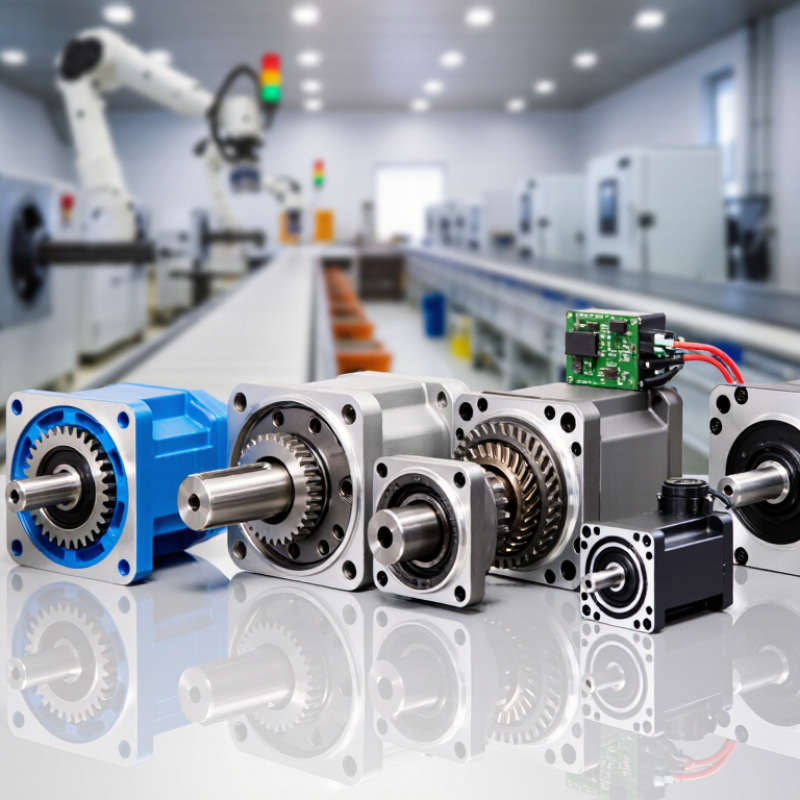
What Are the Top Smart Gear Motor Types in 2026?

What Is a Smart Gear Motor and How Does It Work?

A smart gear motor combines an electric motor, a reduction gearbox, and electronic controls. The motor creates rotation, while the gears reduce speed and increase usable torque. Sensors and a controller can monitor factors such as speed, position, or temperature. Together, these parts help the motor respond to changing demands instead of running at one fixed output.

Here is the basic loop. A controller receives a target, such as moving a small conveyor at a set speed. Sensor feedback reports what the motor is actually doing. If the load changes, the controller can adjust power to bring operation closer to the target. Gear ratio matters: a high reduction ratio can provide more torque, but usually lowers output speed. That trade-off is easy to overlook.

In 2026, smart gear motors may use different gear designs, including planetary, spur, or worm arrangements, depending on space, load, and efficiency needs. A compact actuator might favor a planetary gearbox, while a right-angle layout may suit a worm design. The best choice depends on real operating conditions, not just a specification sheet. Heat, backlash, mounting, and maintenance access all matter. Small details count. And sensor readings are not perfect; poor calibration or vibration can make feedback less useful, so setup and testing remain important.

Which Smart Gear Motor Types Are Common in 2026?

In 2026, smart gear motors commonly use planetary, helical, spur, worm, or harmonic gearsets. “Smart” usually refers to added electronics, not one specific gear shape. An encoder can report shaft position, while a temperature sensor can flag overheating. Some units also support speed commands and fault monitoring through a connected controller.

Planetary gear motors suit compact machines that need high torque, such as robotic joints or automated handling equipment. Helical gears tend to run smoothly and quietly, making them useful in conveyors and precision machinery. Spur gear motors are simpler and often economical, though they can produce more noise at higher speeds. Small details matter. A noisy drive near a worker can become tiring over a full shift.

Worm gear motors turn motion through a right angle and may resist back-driving, but that behavior depends on design and operating conditions. Harmonic gear motors offer high reduction and low backlash for precise positioning, though they may cost more and require careful load checks. Sensors do not fix a poor gear choice. Match the motor to torque, speed, duty cycle, available space, and expected shock loads; then confirm those figures against the manufacturer’s data. A spreadsheet helps, but real operating conditions can still surprise you.

How Do Gearbox Designs Affect Motor Performance?

A smart gear motor is only as useful as its gearbox suits the load. The gear ratio sets output speed and torque: higher reduction usually means slower motion and more output torque, before losses. That can help a compact conveyor start with a heavy tray. But ratios do not create power. Losses matter.

Spur gearboxes are compact and often efficient, though tooth engagement can produce more noise. Helical gears engage gradually and typically run more smoothly, but their angled teeth create axial forces that bearings must handle. Planetary designs arrange several gears around a central sun gear, sharing load in a compact package. They suit tight spaces, although alignment and lubrication still matter. Worm gearboxes can provide large reductions in one stage, but sliding contact may increase heat and reduce efficiency.

For a smart actuator, backlash affects positioning: the output may shift slightly when direction changes. Testing with the actual payload, duty cycle, and mounting position is more useful than relying on a catalog torque figure alone. Watch the gearbox temperature after repeated starts. I would not choose by gear type alone; details such as lubrication and bearing support can change performance. That deserves a closer check.

Top Smart Gear Motor Types in 2026: How Gearbox Designs Affect Motor Performance

Comparison of common geared motor configurations and the performance trade-offs influenced by gearbox design.
Gear Motor Type Typical Gearbox Design Common Reduction Range Efficiency Considerations Backlash and Motion Quality Main Performance Advantages Typical Applications Smart-System Integration
Planetary gear motor One or more planet gears rotate around a central sun gear inside a ring gear. Coaxial input and output are common. Often about 3:1–10:1 per stage; multiple stages provide higher total ratios. Generally high for a compact reducer. Losses rise with additional stages, high ratios, poor lubrication, or operation far from the rated load. Typically low to moderate; precision versions can reduce backlash further. High torque density, compact construction, and good load sharing make this a versatile design. Robotics, automated guided vehicles, machine tools, packaging equipment, and compact servo drives. Frequently paired with encoders, brakes, temperature sensors, and servo or brushless motor controls. These features are selected separately from the gear design.
Spur gear motor Parallel shafts use straight-tooth gears, commonly in one or more reduction stages. Often about 3:1–10:1 per stage; higher ratios usually require additional stages. Can be efficient because the tooth geometry is relatively simple. Efficiency depends on stage count, materials, lubrication, and operating conditions. Backlash is often moderate; tooth contact can produce more audible noise than helical gearing. Simple, economical, and suitable for many low- to medium-torque applications. Small appliances, conveyors, feeders, and general-purpose automation. Can be combined with an encoder or electronic speed controller for speed feedback and basic motion control.
Helical gear motor Parallel shafts use angled teeth that engage progressively. Thrust loads are created and must be managed by the bearing arrangement. Often about 3:1–10:1 per stage; multistage gearboxes can provide higher reduction. Typically efficient, though sliding contact and bearing loads contribute to losses. Actual performance depends on design and duty cycle. Smoother and often quieter than comparable spur gearing; backlash depends on gear accuracy and adjustment. Quiet operation and smooth transmission of substantial loads. Industrial conveyors, mixers, pumps, and production machinery. Well suited to sensor-equipped drives where smooth speed regulation, load monitoring, or predictive maintenance is required.
Worm gear motor A screw-like worm drives a mating worm wheel, usually in a right-angle arrangement. Single-stage reductions commonly range from roughly 5:1 to 100:1, depending on geometry and product design. Can be lower than other common gearbox types, especially at high ratios, because of sliding contact. Lubrication and operating temperature are important. Can provide substantial reduction in a compact right-angle package; backlash varies by design. Self-locking is not guaranteed and depends on geometry and conditions. High reduction in one stage, compact right-angle layout, and smooth operation at moderate speeds. Positioning tables, lifts, gates, packaging machinery, and low-speed drives. Motor-current and temperature monitoring can help identify overload or heat buildup. A separate brake may be needed when load holding is safety-critical.
Bevel gear motor Intersecting shafts use bevel gears; spiral-tooth versions provide more gradual tooth engagement than straight-tooth versions. Often near 1:1–5:1 in a single stage; larger reductions may use additional stages. Can be efficient, particularly with well-designed spiral bevel gearing. Alignment, lubrication, and bearing loads affect losses. Motion quality depends on gear type and adjustment; spiral bevel designs generally run more smoothly than straight bevel designs. Changes drive direction, commonly by 90 degrees, while transmitting useful torque. Right-angle conveyors, machine tools, mixers, and compact drive systems. Can be integrated with encoder-equipped motors for coordinated right-angle drives; the gearbox itself does not provide sensing or control.
Harmonic (strain-wave) gear motor A flexible spline is deformed by a wave generator and engages a circular spline, enabling a high ratio in a compact stage. Single-stage ratios commonly fall around 30:1–160:1, depending on the design. Efficiency varies with ratio, load, speed, and design; it can be lower than that of a well-matched planetary reducer, particularly under demanding conditions. Very low backlash is a key characteristic, making this design suitable for precise positioning. High reduction, compact size, and strong positioning precision. Robotic joints, optical positioning, precision automation, and compact rotary axes. Often used with high-resolution encoders and servo control. Torsional compliance and load-dependent behavior should be considered when tuning a control system.
Cycloidal gear motor An eccentric input drives a cycloidal disc against pins or rollers, commonly with multiple contact points sharing the load. Single-stage reductions often range roughly from 10:1 to 100:1, depending on the design. Performance depends on size, speed, lubrication, and load. Multiple contact points can support high loads, but they do not eliminate frictional losses. Can offer low backlash in precision configurations; vibration and motion ripple depend on disc geometry and manufacturing accuracy. High shock-load capacity and compact high reduction, with robust torque transmission. Robotics, indexing equipment, heavy-duty automation, and industrial positioning. Encoder feedback and drive monitoring can support precise motion and condition tracking; control tuning should account for gearbox stiffness and inertia.

Interpretation note: Reduction ratios and performance descriptions are indicative ranges, not guaranteed specifications. Efficiency, backlash, torque capacity, noise, and service life vary with gearbox size, tooth geometry, manufacturing quality, lubrication, temperature, speed, load, and maintenance. A gearbox changes the relationship between motor speed and output torque; it does not create power, and a higher reduction can also increase reflected inertia and affect dynamic response.

Where Are Different Smart Gear Motors Used?

Smart gear motors fit different jobs depending on torque, speed, space, and control needs. Compact planetary gear motors often suit robotic joints and automated pick-and-place equipment. Their layered gears can deliver high torque in a small package, while encoders help controllers track position. A robot arm moving a small part needs repeatable stops, not just raw power. Fit matters.

Helical and spur gear motors commonly drive packaging lines, conveyor belts, and sorting systems. They work well when equipment needs steady rotation and frequent speed adjustments. Worm gear motors can suit compact lifts, adjustable fixtures, or positioning tables where a right-angle drive saves space. Their efficiency varies with design and load, so heat and duty cycle should be checked before selection. Loads change.

In ventilation dampers, greenhouse vents, and small agricultural machines, smart gear motors can adjust openings based on sensor readings. These applications benefit from controlled movement, but dust, moisture, vibration, and temperature affect service life. A motor that performs well on a clean test bench may behave differently beside a dusty conveyor. That gap is easy to underestimate. Check the gearbox rating, feedback method, and real operating cycle together; choosing by motor power alone can lead to poor positioning or excess wear.

How to Choose a Smart Gear Motor for a Specific Application?

Choosing a smart gear motor begins with the motion your application needs, not the feature list. Planetary gear motors suit compact systems needing high torque. Spur types can offer straightforward, efficient motion at a lower cost. Worm gear motors provide high reduction ratios, while helical designs often run more smoothly under continuous loads. Some units add encoders or built-in controllers for speed and position feedback. Match the type to the task.

Measure the actual load, including startup peaks, not just the average operating force. Check required speed, duty cycle, available space, mounting position, and ambient temperature. A small conveyor may need steady torque for hours; a camera mechanism may need precise, quiet movement. Confirm that the gearbox’s rated output torque and the motor’s thermal limits cover those conditions. Leave a sensible margin.

Then compare control and feedback needs. An encoder helps verify position, but it cannot fix poor mechanical alignment. Review voltage, communication signals, shaft dimensions, and the controller’s compatibility before ordering. Numbers can mislead. A motor that looks adequate on paper may overheat during repeated starts. Test a sample under real load, listen for vibration, and record temperature over a full operating cycle. I would not skip this step, even when the calculations look convincing.

Top Smart Gear Motor Types in 2026: Typical Gearbox Efficiency

Indicative efficiency ranges vary with design, reduction ratio, lubrication, load, and operating conditions.

How to choose: Helical and planetary gear motors are common choices when efficiency matters; planetary designs also suit compact, high-torque applications. Spur gear motors are often a straightforward option for simpler, lower-cost systems. Worm gear motors can provide high reduction in a compact arrangement, but may lose more energy as heat. Harmonic gear motors are useful where compact size and low backlash are priorities. Compare the specific motor’s rated torque, speed, duty cycle, backlash, thermal limits, and efficiency curve for your application.

FAQS

Where are compact planetary gear motors commonly used?

They suit robotic joints and pick-and-place equipment. Their compact gear sets can deliver high torque. Encoders help track position. Fit matters.

Which gear motors work well on conveyor and packaging lines?

Helical and spur gear motors can provide steady rotation for conveyors, packaging lines, and sorting systems. They also support frequent speed adjustments.

When might a worm gear motor be a suitable choice?

It can suit compact lifts, adjustable fixtures, and positioning tables. Its right-angle drive can save space. Check heat and duty cycle.

What conditions can affect a smart gear motor outdoors or near machinery?

Dust, moisture, vibration, and temperature can shorten service life. A clean test bench may not reflect a dusty conveyor. That gap matters.

What should I measure before choosing a motor?

Check the actual load, including startup peaks, required speed, duty cycle, space, mounting position, and ambient temperature. Average force alone can mislead.

Does an encoder guarantee accurate positioning?

No. An encoder provides position feedback, but it cannot correct poor mechanical alignment. Check the gearbox rating and feedback method together.

How can I check whether a motor will handle its real workload?

Test a sample under the actual load. Run it through a full operating cycle, then record temperature and listen for vibration. I would not skip this, even if the calculations look convincing.

What should I verify before ordering a smart gear motor?

Confirm output torque, thermal limits, voltage, communication signals, shaft dimensions, and controller compatibility. Leave a sensible margin. Paper specs are not the whole story.

Conclusion

A Smart Gear Motor combines an electric motor, a gearbox, and often built-in sensing or control features to deliver motion with greater precision and efficiency. Common types in 2026 include spur, planetary, worm, helical, and bevel gear motors, each offering a different balance of torque, speed, size, noise, and durability. Gearbox design strongly influences performance: for example, a compact planetary arrangement can provide high torque density, while a worm gearbox can offer substantial speed reduction in a small space.

These motors serve a wide range of applications, from robotics and automated production equipment to medical devices, smart appliances, and mobility systems. Choosing the right option means matching the motor to the load, required speed and torque, available space, operating environment, duty cycle, and control needs. Considering efficiency, precision, noise, maintenance, and compatibility with sensors or controllers can help ensure reliable performance throughout the application’s service life.

Ethan

Ethan

Ethan is a seasoned marketing professional with a deep expertise in our company's innovative product line. With a passion for sharing knowledge and insights, he takes the lead in regularly updating our corporate blog, where he explores industry trends, product features, and effective marketing......